During a recent conversation with fellow doctoral researchers, our discussion shifted unexpectedly from research methods and academic writing to something far less tangible. One colleague posed a question that immediately resonated with the group:
“At what point does AI stop being a tool and start influencing how we think?”
What followed was not a debate about plagiarism, academic misconduct, or whether artificial intelligence (AI) belongs in higher education. Instead, we found ourselves sitting with a growing sense of uncertainty that none of us had quite named before. Some researchers worried about becoming overly dependent on AI tools. Others questioned whether generative AI was quietly changing the nature of scholarly work itself. A few admitted feeling pressure to adopt these technologies simply to keep pace with shifting expectations.
None of us were rejecting innovation. Most of us use AI in some capacity. Yet beneath the excitement surrounding these tools was a shared concern that proved surprisingly difficult to articulate.
The issue was not technology. It was agency.
Beyond Fear of Technology
As generative AI becomes embedded in education, research, and professional communication, many educators and scholars are experiencing a form of psychological and professional uncertainty that deserves far greater attention. One concept that helps explain this experience is algorithmic anxiety.
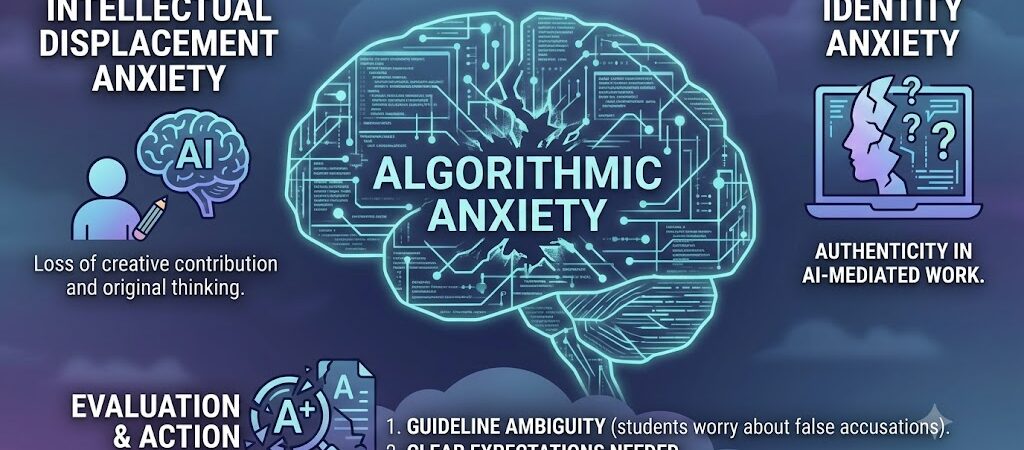
At the CAID Center, we define algorithmic anxiety as the uncertainty, stress, and diminished sense of agency individuals experience when navigating environments increasingly shaped by algorithmic systems, automated decision-making, and generative AI technologies.
This anxiety does not arise simply from using technology. It emerges from uncertainty about how algorithms influence our thinking, professional performance, visibility, creativity, and ultimately, our sense of self.
Unlike technophobia, which refers to a general fear or distrust of technology, algorithmic anxiety reflects a more specific and relational experience. It surfaces when people operate within systems that guide recommendations, evaluate performance, shape communication, and influence decision-making in ways that are often invisible to the people most affected by them.
For students, it may appear as uncertainty about whether their work is genuinely their own. For educators, it may emerge as tension between embracing innovation and preserving academic integrity. For researchers and professionals, it can manifest as pressure to continuously adapt to technologies that seem to redefine expertise faster than institutions can respond.
Why Naming It Matters
Communication scholars have long understood that language shapes perception. The words we choose influence how we interpret experiences, identify problems, and imagine solutions.
When a phenomenon lacks a name, it often remains invisible and isolation follows. People experience frustration, confusion, or self-doubt without recognizing that colleagues and students sitting in the very next room are navigating the same uncertainty.
Naming algorithmic anxiety gives educators, researchers, and students a shared framework for understanding what they are experiencing.
When we name something, we create the possibility for dialogue. When we create dialogue, we create space for reflection, adaptation, and action.
Without language, anxiety becomes noise. With language, it becomes something we can examine, discuss, and address together.
Naming algorithmic anxiety is not about resisting technological change. It is about honoring the human dimensions of it.
Three Signs of Algorithmic Anxiety
Although algorithmic anxiety can take many forms, three patterns are becoming increasingly visible in educational environments.
- Intellectual Displacement Anxiety: This occurs when individuals begin questioning the relevance of their own knowledge, expertise, or creative contribution. Students may wonder whether their ideas are genuinely original. Faculty members may question how years of disciplinary expertise compare to systems capable of generating polished responses in seconds. Researchers may feel pressure to adopt AI tools not because they find them useful, simply to remain competitive. The concern is rarely that AI is replacing human intelligence outright. Subtler than that, it’s a growing uncertainty about where human contribution still matters, and whether it is still valued.
- Evaluation Anxiety: As AI tools become integrated into learning and professional environments, many individuals grow uncertain about how their work will be judged. Students worry about being falsely accused of inappropriate AI use. Instructors struggle to distinguish between legitimate assistance and academic misconduct. Professionals question whether performance expectations have quietly shifted without any clear communication. In many cases, the anxiety stems not from the technology itself but from the ambiguity surrounding it; it is the absence of clear, transparent, and equitable guidelines.
- Identity Anxiety: Perhaps the most profound form of algorithmic anxiety involves questions of authenticity and voice. Students increasingly use AI to draft messages, generate ideas, and assist with communication tasks. Educators may feel pressure to automate aspects of their teaching. Professionals produce AI-assisted content while quietly wondering whether their own perspective is becoming diluted. These experiences raise questions that are not technical in nature. They are communication questions, and they are precisely the questions the CAID Center was built to engage:
- What does authentic communication look like in an AI-mediated environment?
- How do we maintain agency while benefiting from technological assistance?
- Where does human identity fit within increasingly automated systems?
What We Can Do
The goal is not to eliminate uncertainty. Uncertainty has always accompanied periods of significant technological and social change. The goal is to create environments where questions about AI, agency, and professional identity can be raised openly, examined critically, and addressed constructively.
Three practical starting points:
- Create space for honest conversation: Many students, educators, and researchers are already navigating these questions privately, often without a shared language to describe what they are feeling. Bringing these discussions into classrooms, faculty meetings, research groups, and professional development spaces reduces isolation and models the kind of critical reflection we want to cultivate in our students.
- Make expectations explicit: Uncertainty amplifies anxiety; clarity reduces it. Educators should communicate transparently about when, where, and how AI tools may be used in their courses. Institutions should move toward policies that balance innovation with accountability, policies that are clear enough to guide behavior and flexible enough to evolve as the technology does.
- Reinforce the irreplaceable value of human judgment: AI can support many aspects of communication, research, and decision-making. But it does not replace ethical reasoning, contextual understanding, empathy, or critical thought. Educators have a particularly important role in naming and reinforcing these capacities not as a nostalgic defense of the past, but as a forward-looking commitment to what education is actually for.
Looking Forward
That conversation with my colleagues eventually moved well beyond AI itself. What began as a discussion about tools became a conversation about expertise, authorship, and identity, about what it means to think, create, and communicate in an era of automated systems.
As AI becomes more deeply embedded in educational, professional, and social life, these questions will only grow more pressing. Naming algorithmic anxiety is not an act of resistance. It is an act of recognition, an acknowledgment that the humans navigating these systems deserve language, frameworks, and communities of support equal to the complexity of what they are experiencing.
At the CAID Center, we believe that technological advancement must be accompanied by critical reflection, ethical engagement, and meaningful dialogue. The future of AI is not solely a technical challenge. It is a communication challenge, a pedagogical challenge, and fundamentally, a human one. Understanding that challenge begins by giving it a name!